Table Of Content

Another factor in human evolution that also occurred in the prehistoric past was a preferential selection for neoteny, particularly in females. The idea that adult humans exhibit certain neotenous (juvenile) features, not evinced in the other great apes, is about a century old. However, while men develop longer, coarser, thicker, and darker terminal hair through sexual differentiation, women do not, leaving their vellus hair visible.
General structural features from the X-ray experiments
Initial Parameters were chosen based on the observed positions, widths and heights of the peaks and free to move through the entire q-range. The criterion for the final parameters was to minimize the mean square of the difference between data intensity and the fitted intensity. If the fitted intensity cannot conform to the shape of the data intensity, more peaks will be added in the following runs until a good fit is acquired. This process was repeated for all 12 subjects and performed with little or no consultation of previous fittings to minimize bias.
What is a hair follicle?
The degree of axial symmetry within the hair bulb determines the curvature of the final hair structure [35]. Fiber length is often dependent on the duration of the anagen or actively growing phase of the follicle [17]. The featured regulatory proteins in anagen phase are BMPs, sonic hedgehog, several WNT proteins and receptors.
Hair Growth
Meanwhile, the wavey hair of European people gives an oval shaped cross section, and the curly hair of black people has a kidney-shaped cross section. Hair follicles (the sheath of cells that surround the base of each hair) head tend to be long and straight, but curly hair is often produced from curved hair follicles. Despite the unique differences between hair around the world, the basic histology of hair is universal. The size of hair follicles varies considerably during the existence of the follicles.
Camilla Luddington Dyes Hair Blonde Ahead of Grey's Anatomy Season 18: 'New Era' - PEOPLE
Camilla Luddington Dyes Hair Blonde Ahead of Grey's Anatomy Season 18: 'New Era'.
Posted: Fri, 17 Sep 2021 07:00:00 GMT [source]
Alopecia is an autoimmune disease mediated by T lymphocytes and other immune cells. As its name might suggest, this type of tissue forms a loose connection between the epicranial aponeurosis and the pericranium. This allows the other layers of the scalp to slide of over the pericranium. Loose areolar tissue comprises a network of reticular fibers, elastic tissue, and collagen. Since this is a loose connective tissue, cell types vary beyond fibrocytes and can include plasma cells, mast cells, and adipocytes.
Unpacking Sienna Miller's Effortless Hair And Make-Up In 'Anatomy Of A Scandal' - British Vogue
Unpacking Sienna Miller's Effortless Hair And Make-Up In 'Anatomy Of A Scandal'.
Posted: Fri, 22 Apr 2022 07:00:00 GMT [source]
Wherever you have hair on your body, you also have hair follicles. Hair follicles originate in the first and second layers of your skin (epidermis and dermis). Follicles holding your terminal hair, or the hair that grows on your scalp, eyelashes and eyebrows, extend into the first and second layer of your skin and sometimes into the third layer (subcutaneous tissue).
The only "living" portion of the hair is found in the follicle. The hair that is visible is the hair shaft, which exhibits no biochemical activity and is considered "dead". In humans with little body hair, the effect results in goose bumps.
A lot of cellular activity happens during this phase so that the tissues can regenerate and grow more hair. In other words, the telogen phase is crucial to the formation of healthy hair. The full strand of hair develops from this group of hardened hair cells. Because new hardened cells keep on attaching to the hair from below, it is gradually pushed up out of the skin. In this way, a single hair on your head grows at a rate of about 1 cm per month.
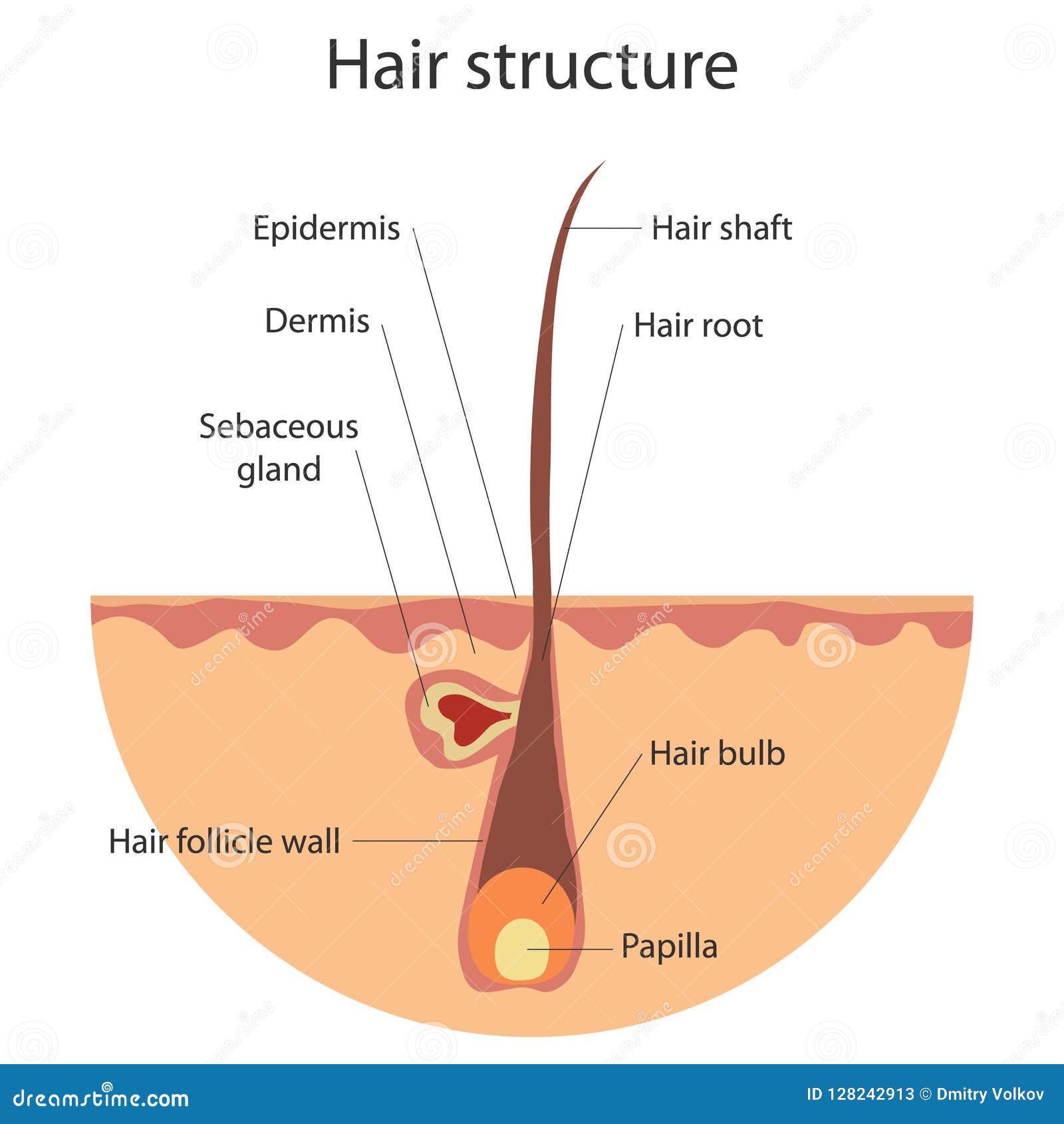
Hair and follicle morphology
The middle layer of the hair shaft (hair cortex) constitutes the bulk of the hair and consists of cells that keratinize gradually as they move upward from the hair matrix. Unlike the IRS, which keratinizes by forming trichohyalin granules (soft keratin), the hair cortex cells keratinize without forming granules (the aforementioned trichilemmal keratinization). However, they keratinize relatively low in the hair follicle and are indistinguishable at higher levels, where they function as a single unit covering the hair shaft.
It protects your skin and traps particles like dust around your eyes and ears. If your hair gets damaged, it can renew itself without scarring. As expected, the identical twin pair shows almost identical hair structures whereas the fraternal pair exhibits distinct differences. Offspring receive half of their chromosomes from each parent, thus the genetic similarity between the parent and child pair is roughly the same as fraternal twins (Creasy et al., 2013). It is, therefore, surprising that the father and daughter pair share significantly more similarities than the pair of fraternal twins.
It is substantiated by Iyengar's findings (1998) that UV light can enter into straight human hair roots (and thus into the body through the skin) via the hair shaft. Specifically, the results of that study suggest that this phenomenon resembles the passage of light through fiber optic tubes (which do not function as effectively when kinked or sharply curved or coiled). In this sense, when hominids (i.e. Homo erectus) were gradually losing their straight body hair and thereby exposing the initially pale skin underneath their fur to the sun, straight hair would have been an adaptive liability.


No comments:
Post a Comment